 Store
Store
How much does a coffee bar cost in Lebanon?
Search for it and you will struggle to find a single reliable figure. The results are dominated by foreign guides quoting $80,000 to $300,000 — inflated numbers that have little to do with the Lebanese market.
If you plan to open a coffee shop in Lebanon, this guide focuses on the part of the business that shapes every cup you serve — the coffee bar — and prices it in Lebanese terms.
In Lebanon, a fully working espresso bar starts at around $3,500, and budgets rise across four levels to $10,000 and beyond.
Rent, fit-out and the space itself vary too much from one location to another to price in a general guide, but the bar does not. What follows is based on local figures: what the equipment costs, what Lebanon’s electricity situation really demands, what a new café can expect to sell in its first year, and where owners most often lose money.
What the equipment actually costs
These figures cover the espresso bar itself: the machine, grinders, refrigeration, water treatment and small tools. They do not include rent, furniture, signage or the premises.
Equipment budget, Lebanon
| Level | Cost |
|---|---|
| Entry | ~$3,500 |
| Entry Plus | $4,000–6,000 |
| Professional | $6,000–10,000 |
| Premium | $10,000 and up |
What these prices cover
Included: fully automatic espresso machines (the barista grinds and tamps, and the machine stops each shot automatically) and hybrid gas/electric machines.
Not included: super-automatic, one-touch machines that grind, brew and steam on their own; under-counter systems; and special or custom-ordered machines.
Lever machines fall outside the scope of a coffee shop, and semi-automatic machines — where the barista starts and stops every shot manually — are not recommended for a commercial bar.
Choosing new or used equipment affects the total more than any other decision. A properly serviced, second-hand two-group machine from a reputable brand will outlast a new unbranded one, and cost less.
Power: the part nobody writes about
Guides written outside Lebanon rarely mention it, yet here it often determines what you can buy.
A conventional electric espresso machine draws 14 to 25 amps, depending on the model. That is a heavy load to sustain through power cuts, on a generator or on an inverter — and it is the reason many bars struggle to run properly, or at all.
Hybrid machines: 1.5 to 2 amps
A hybrid machine heats its water with gas, much like a stove at home, and uses electricity for everything else. Running on gas, it draws roughly 1.5 to 2 amps instead of 14 to 25.
During a rush, the barista can switch on the electric heating as well. The gas keeps assisting and the water heats faster. The machine does not switch over automatically, so the electrical load is only there when the barista decides it is needed.
For most new cafés in Lebanon, this is the single most valuable decision on the list. It changes the size of generator you need, what your inverter has to carry, and whether service can continue through a long outage.
Give the machine a dedicated line
Whichever type you choose, the machine needs a dedicated line from the electrical board — not a shared circuit, and never an extension cable. It is a safety requirement before it is a performance one, and the least expensive item in this guide to get right.
Water treatment: $800 to $2,000, and essential
Untreated water in Lebanon will scale a boiler and shorten the life of every heated component on the bar. A reverse osmosis system costs $800 to $2,000 installed.
Test the water first
There is no one-size-fits-all system. The water at your premises should be tested first, and the treatment chosen to match its hardness.
Treat more than the espresso machine
Treated water should supply everything that goes into a drink:
- the espresso machine
- the filter or batch brewer
- the ice machine, if you have one
- the drinking-water tap you serve customers from
Filters wear out over time. Replace them on the schedule your installer recommends, not when the coffee starts to taste off.
Water treatment is often skipped because the machine works perfectly on day one — and still does three months later. Sooner or later, though, the boiler scales, recovery slows, shots become inconsistent, and the repair costs more than the system would have. Install it from the start.
Refrigeration: plan it around the bar
Behind the bar, you need cold storage for two purposes:
- An under-counter fridge for milk.
- A freezer for ice, required only if you buy ice in rather than installing an ice maker.
What matters most is placement. Size and position them to suit the bar layout, so the barista can reach the milk without stepping away from the machine.
Small tools you need from day one
They cost little compared with the machine, but the bar cannot run without them:
- Tamper and tamping mat — for compressing coffee evenly in the portafilter.
- Milk jugs in several sizes — for different cup sizes and latte art.
- Scale and knock box — for weighing every shot and disposing of used coffee pucks.
- Cleaning kit — brushes, cloths, backflush detergent and a blind basket.
See tampers and distributors and cleaning and maintenance products.
What a new café actually sells
There is no single answer. First-year sales depend on several factors:
- Location — prime or secondary, with heavy foot traffic or without.
- Size and seating — indoor and outdoor capacity.
- Facilities — high-speed internet, a pet-friendly environment, and similar.
- Menu — a full kitchen, ready-made cold items, or a third-party supplier delivering fresh each morning to minimise waste and overheads.
- Brand and identity.
- Surrounding competition.
A starting assumption
For planning purposes, start from 50 orders a day at an average of $6 per order, counting weekdays only.
Sales at 50 orders a weekday, $6 per order
| Period | Sales |
|---|---|
| One weekday | $300 |
| One week (5 weekdays) | $1,500 |
| One month (about 22 weekdays) | about $6,600 |
Plan around an ordinary weekday, not your busiest Saturday.
Coffee consumption
At 14 g per double shot with 3% waste, a 1 kg bag yields about 69 double shots. At 50 orders a weekday, that comes to a maximum of:
- about 0.72 kg a weekday
- about 3.6 kg a week (5 weekdays)
- about 15.9 kg a month (about 22 weekdays)
These are upper limits, since they assume every order is a coffee; food and other drinks will bring them down. Use these figures to plan your coffee and milk orders (see wholesale coffee for cafés), your staffing, and whether the rent is sustainable.
Many owners build their plans around the busiest hour they can imagine, only to find their equipment, staff and stock sized for a café that does not exist yet. Plan for the starting assumption, and leave room to grow.
How a café bar is laid out
Below is an example plan showing one way a bar can be laid out. Seen from the front, it follows the flow of service from left to right: orders are taken at the till, coffee is ground and then brewed and steamed at the machine, cold drinks are blended at the mixer directly above the ice bin, and every drink is handed over at the raised pick-up bar at the end.
Milk is stored in the fridge beneath the machine, and the water treatment system sits under the pick-up bar, beside the sink and the filter brewer.
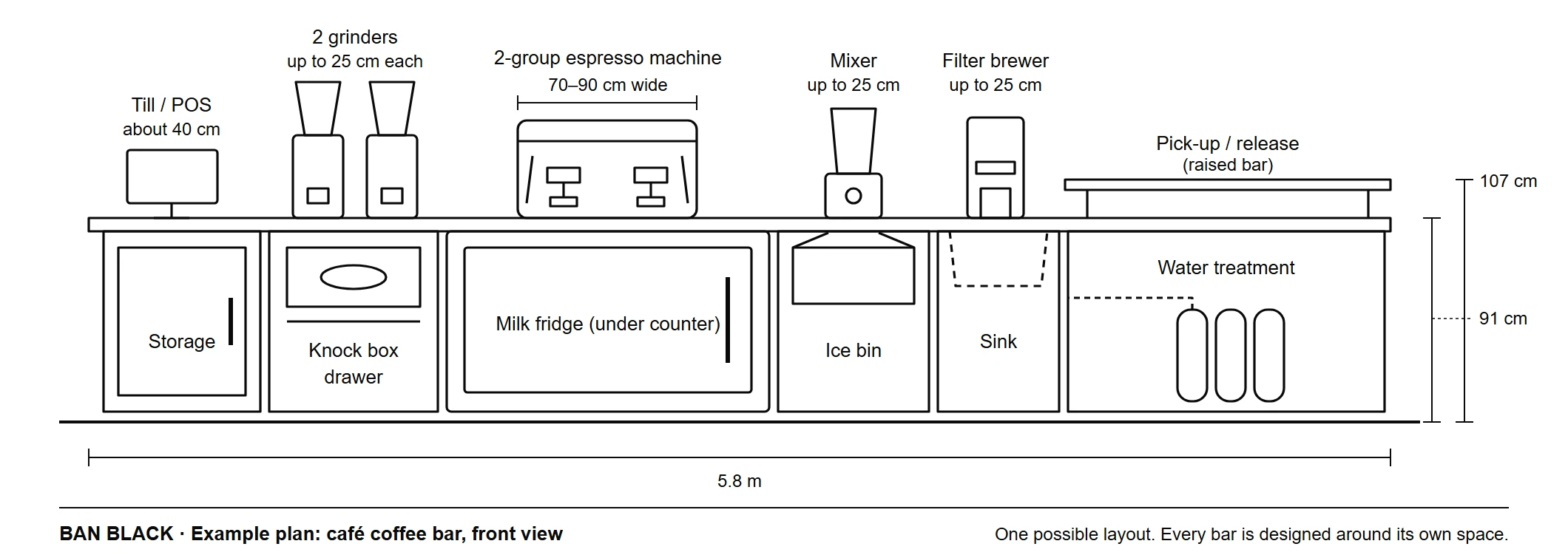
Counter space per item
| Item | Width |
|---|---|
| Till / POS (15-inch touchscreen) | about 40 cm |
| Each grinder | up to 25 cm |
| Two-group espresso machine | 70–90 cm |
| Mixer | up to 25 cm |
| Filter brewer | up to 25 cm |
Before you build the bar: prerequisites
Three things must be in place before any equipment is installed.
1. Electricity
- Every item needs its own socket.
- Wiring must be rated for each item’s load. Size it to what each machine draws.
- Machines drawing more than 10 amps should use an industrial plug, the safer and preferred option.
- Never put the whole bar on a single circuit breaker.
2. A water tank
Treated water is fed into a small tank, from which the machine draws its supply. Monitor the level so the tank never runs dry.
3. Drains
Install a drain close to every unit that requires one:
- the espresso machine
- the ice bin
- the sink
Choosing the espresso machine
Start with two numbers: how many drinks you expect to sell each day, and how many of those fall within your busiest hour. The rush hour determines the size of machine you need. Power and budget come second, as they only narrow the choice among machines that already suit your volume.
There are two main options, each available new or used:
- Multi-group hybrid, new or used — the low-amperage option, and the best suited to Lebanon’s electricity supply.
- Multi-group electric, new or used — for locations with reliable power or a generator sized to match.
Two groups or three? Size for the rush hour
The machine has to keep pace with your busiest hour, not your daily average. Two examples illustrate the point:
Rush hour: 80% of the day’s cups in one hour
| Cups a day | In the rush hour | Per minute | Machine |
|---|---|---|---|
| 100 | 80 | about 1.3 | Any standard two-group |
| 400 | 320 | about 5.3 | Three groups |
Cafés serving 400 cups a day do exist in Lebanon. At that pace, a two-group machine lacks the power to hold its temperature and deliver consistent, perfect steam, so a three-group becomes necessary.
Four points to keep in mind:
- These are hypothetical examples. Do your own research and calculations to estimate how many cups you will serve at peak times.
- Check the manufacturer’s daily capacity. Most machines are rated for a daily limit — for example, up to 250 cups — which helps you choose the right model.
- Hybrid machines are slower during a heavy rush. Gas heats water more slowly than electricity, so decide carefully when to run on gas and when to switch on the electric heating.
- Installing a three-group before you need one? Choose a hybrid. If you have the opportunity to install a three-group machine but your volume does not yet justify it, a hybrid will keep your monthly electricity bill down. At the time of writing, electricity in Lebanon cost up to 65 cents per kWh, among the highest rates in the world.
The most important rule: the barista
The human factor plays a major role. A three-group machine may handle the pressure of a peak hour, but with only one or two baristas behind the counter, the bottleneck becomes the baristas, not the machine.
If you plan to have a single barista on shift during the rush, a three-group machine will not make them any faster.
The brand matters less than the fit
La Marzocco, Victoria Arduino, Faema, Rancilio, Gaggia, SAB and Expobar all build machines designed for commercial bars. No single brand is right for every café; the right machine is the one that fits your volume, your power supply and your budget.
After the purchase
A machine you can keep running matters more than the one you buy. Before paying, check four things:
- Spare parts in Lebanon. If a part has to be ordered from abroad, a breakdown can close your bar until it arrives.
- A technician who knows that machine. A local technician with experience servicing that specific model.
- A maintenance routine. Scheduled gasket and shower-screen replacement and backflushing, not only repairs when something fails.
- A local warranty, in addition to the manufacturer’s.
Choosing the grinder
This is the rule most people get backwards: the grinder shapes the cup more than the machine does. An excellent machine paired with a poor grinder produces poor espresso, while a modest machine with a good grinder makes coffee people come back for. If the budget is tight, prioritise the grinder. Browse electric coffee grinders, including Eureka.
Size it the same way as the machine, by drinks per day. A busy bar needs larger burrs and a motor that can keep up through the rush.
Start with two grinders
Use one for your house espresso and a second for decaf or filter, so no one has to readjust a single grinder between coffees in the middle of service.
Two features worth paying for
- Grind by weight. The grinder doses by weight automatically, so every shot receives the same amount of coffee without the barista weighing it.
- Large flat burrs. Faster grinding and a more consistent particle size at café volumes.
Keep the menu to 10–20 drinks
Ten to twenty drinks is the right size for a new café: espresso and milk-based drinks, one or two filter options, a small cold selection, and a couple of signature items of your own.
A thirty-item menu slows the bar, spreads your stock across perishable ingredients and doubles training time. It also hides what you do best. Expand later, once you know what customers actually order.
Staff: about a month to become proficient
A new hire with no experience takes roughly one month to become genuinely effective behind the machine: pulling consistent shots, steaming milk well, and handling a rush without the bar falling apart.
Budget for that month. A barista learning on live service without training costs you in wasted coffee, wasted milk and customers who do not return.
The four mistakes we see most
- Overspending on the machine, then buying a cheap grinder. The grinder has the greater effect on the cup, yet usually receives the smaller share of the budget.
- Skipping water treatment. The machine scales within months, and the repair costs more than the filtration would have.
- Not planning the power. The wrong amperage, no dedicated line and no protection — and the electronics are the first thing to fail.
- Building too big a menu. Slower service, more waste, longer training, and a bar that does nothing especially well.
What else to budget for
Equipment is only one line in the budget. Before opening, you will also need:
- Fit-out, furniture and signage — often costing more than the coffee equipment.
- Opening stock — coffee, dairy, cups, packaging, syrups.
- Working capital — rent and wages for the months before the café covers its own costs.
Working capital is where cafés fail. Equipment is a number you can plan for; three quiet months you did not budget for are what actually close a business.
The short version
Opening a café in Lebanon, in numbers
| What | Figure |
|---|---|
| Coffee bar, Entry | ~$3,500 |
| Coffee bar, Entry Plus | $4,000–6,000 |
| Coffee bar, Professional | $6,000–10,000 |
| Coffee bar, Premium | $10,000 and up |
| Water treatment (reverse osmosis) | $800–2,000 |
| Electric machine draw | 14–25 amps |
| Hybrid machine draw, on gas | 1.5–2 amps |
| Starting assumption | 50 orders/weekday at ~$6 |
| Sales at that level | ~$300/weekday |
| Coffee used, at most | ~3.6 kg/week (weekdays) |
| Menu size | 10–20 drinks |
| Training a new barista | about 1 month |
Frequently asked questions
How much does it cost to equip a coffee bar in Lebanon?
Around $3,500 for an entry-level bar, $4,000–6,000 for Entry Plus, $6,000–10,000 for Professional, and $10,000 and up for Premium. These figures cover the bar equipment only, not rent, fit-out or furniture.
How many amps does a commercial espresso machine need?
A conventional electric espresso machine draws 14 to 25 amps. A hybrid machine running on gas draws roughly 1.5 to 2 amps, and the barista can switch on the electric heating during a rush.
Do I need water treatment for a café espresso machine?
Yes. Untreated water scales the boiler and shortens the life of every heated component. A reverse osmosis system costs $800 to $2,000 installed, and the water should be tested first so the treatment matches its hardness.
Should I buy a two-group or a three-group espresso machine?
Size the machine for your rush hour. If 80% of 100 daily cups fall within one hour — about 1.3 cups a minute — any standard two-group copes. At 400 cups a day, about 5.3 cups a minute, you need three groups. With only one or two baristas, though, the baristas become the bottleneck, not the machine.
How much coffee does a new café use per week?
At 50 orders a weekday, 14 g per double shot and 3% waste, up to about 3.6 kg a week on weekdays. Actual use is lower, since not every order is a coffee.
What electrical setup does a coffee bar need?
Every item needs its own socket and wiring rated for its load, machines drawing more than 10 amps should use an industrial plug, and the whole bar should never sit on a single circuit breaker.
Costing an opening?
Ban Black fits out cafés across Lebanon and roasts the coffee they serve, so equipment is specified around your menu and volume rather than a catalogue: La Marzocco, Victoria Arduino, Faema, Rancilio, Gaggia, SAB and Expobar on the bar, Eureka grinders beside them, and the water treatment and fit-out that keep a busy service running smoothly.
We run a 127-point launch checklist with the owners we work with, covering everything from the electrical board to the first week of service.
See how Ban Black handles complete coffee shop setups, or message our Zouk Mosbeh showroom on WhatsApp at +961 71 888768 and we will plan it with you.